
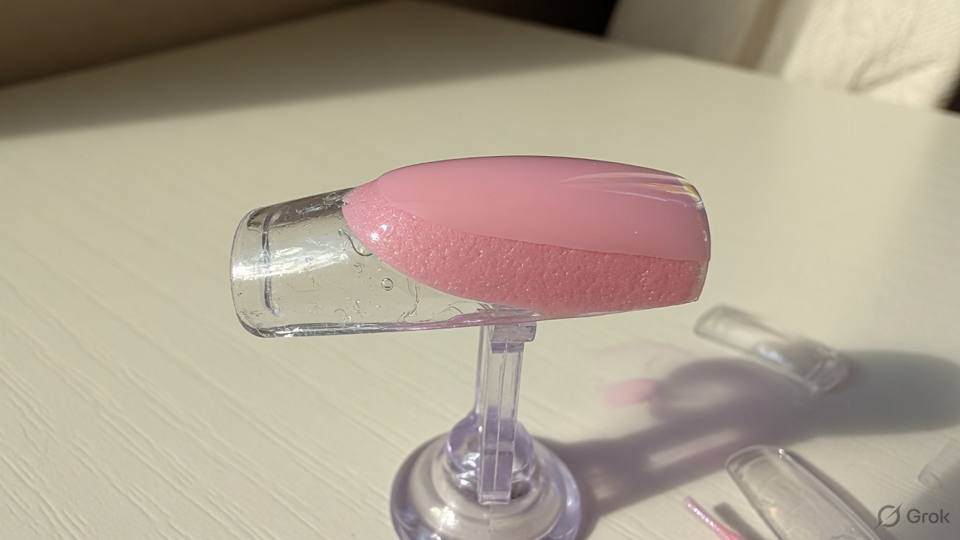
Liquid and powder, hard gel, builder gel
Liquid and powder, often called acrylic, is made by mixing a monomer liquid with a polymer powder. The two react chemically, and the bead sets without a lamp. The technician controls the mix ratio: too wet, and the bead floods the cuticle and shrinks as it sets; too dry, and it drags, looks chalky, and breaks. A workable bead looks like a small bead of honey that holds its shape on the brush. Press and pat it into place rather than pumping the brush, because pumping pushes air into the product and leaves bubbles that weaken the structure. Once set, the surface is filed, and the filing is where the shape and the apex are refined.
Hard gel and builder gel are cured with a lamp rather than mixed with a powder. Hard gel is used for structure and does not soak off easily; builder gel is thicker and is used for overlays, short extensions, and strengthening natural nails. Both need thin layers and a full cure, and both stay where they are placed, which means placement matters more than gravity. They do not smell of monomer, and they usually feel lighter on the nail, but they are not automatically gentler: a gel that touches the skin can still cause a reaction, and a thick layer can still under-cure. Read the product instructions, because the names are used loosely across brands.
Four principles apply to all three systems. First, the mix ratio or the layer thickness must be even, because uneven product cures or sets unevenly and fails at the thin spot. Second, no wet product goes on the skin, because uncured monomer and uncured gel are the most common causes of allergic reaction and lifting. Third, structure is not thickness: a well-placed apex supports the nail, while a thick, flat layer adds weight without strength. Fourth, the removal method must match the product, because acetone that is right for one system is useless for another and a file that is right for one can damage the plate under a third.
Allergy deserves its own paragraph, because it ends careers and clients' ability to wear product. Repeated skin contact with uncured methacrylates can sensitise a person, and once sensitised, the reaction can spread to the face, the eyelids, and the neck. It is not a rash to work through; it is a permanent change. Keep product off the skin, do not double-dip a brush, do not use expired monomer, keep the lid on, and ventilate the room. If a client reports itching, redness, or swelling after a set, remove the product, do not apply more, and refer. If a technician develops a rash, she should stop working with the product and see a doctor, not tape over it.
- 1. Read the product instructions for the mix ratio, layer thickness, and cure time.
- 2. Mix a bead that holds its shape, and do not use a wet bead near the skin.
- 3. Press and pat acrylic into place instead of pumping the brush.
- 4. Apply hard gel and builder gel in thin layers, and cure each one fully.
- 5. Keep every product off the skin, and clean the cuticle gap before it sets.
- 6. Build structure over the stress area rather than adding bulk everywhere.
- 7. Match the removal method to the system on the nail.
- 8. Ventilate the room, keep lids on, and treat a rash as a reason to stop.
Salon example
A client named Farida has worn acrylic for years and wants to try builder gel because she is tired of the smell. The technician explains that the two systems behave differently: acrylic sets in the air and is built with a bead, while builder gel stays where it is placed and needs a lamp. She checks that the client has no history of itching or swelling, then removes the old acrylic by filing it thin and soaking the last layer, without prying. She applies a thin base, a structure layer of builder gel over the stress area, and cures it fully. The first attempt looks a little flat at the apex, so she adds a small amount of product in the right place and cures again rather than making the whole nail thicker. Farida says the nail feels lighter than her acrylic sets. The technician writes the system and the cure time on the card, and at the fill she uses the same products rather than mixing systems without a reason. Farida books the fill at three weeks, and the technician uses the same builder gel so the structure stays predictable.
Caution: Wet product on the skin is how allergies begin; keep the margin clean.
Structure is not thickness
Structure means the shape of the product across the nail: thin at the cuticle, a gentle arch over the stress area, thin at the side walls, and a little strength at the free edge. Thickness means more product everywhere, which adds weight, looks bulky, and does not prevent breaks. A thick, flat nail still snaps at the stress point because there is no arch to spread the impact. A thinner nail with a well-placed apex can survive a knock that would crack a heavy one. When a client asks for a stronger set, the answer is usually better structure and a shorter length, not another layer of product.
The apex sits over the stress area, roughly the middle of the nail and slightly toward the free edge, where the nail bends most when it is pressed. Build it by placing product in that zone and letting it settle into a curve, or by patting acrylic into a subtle dome. The highest point should be smooth, not a lump, and the transition toward the cuticle should be thin enough that the natural nail shows through a clear product. On a short nail the apex is subtle; on a long enhancement it is more pronounced. The apex also needs to be in the right place: too far back, and the free edge levers; too far forward, and the stress point has no support.
The side walls and the free edge complete the structure. The side walls should follow the natural side wall and tuck in slightly, not flare out where they catch on everything. The free edge needs a little product, not a paper-thin rim, because a thin edge chips and a thick edge looks like a shelf. The curve across the nail, called the c-curve, should be gentle and consistent; a flat cross-section bends more easily than a curved one. Look at the nail from the side and from the tip, not only from above. A structure that looks right from the technician's seat can be visibly flat from the client's side of the table.
Filing after the product sets is where structure is either kept or destroyed. File the surface to refine the shape, but do not file the apex down to make the nail look slimmer, because that removes the support and leaves a flat, weak nail. At a fill, check whether the apex has moved forward with growth; if it has, rebuild it rather than adding colour on top of a structure that no longer works. If the structure cannot be rebuilt without removing the set, say so and book the removal. A client would rather hear that at the start than discover it when the nail snaps.
- 1. Look at the nail from the side before you build, and note where it bends.
- 2. Place the apex over the stress area, slightly toward the free edge.
- 3. Keep the product thin at the cuticle and thin at the side walls.
- 4. Give the free edge a little product rather than a paper-thin rim.
- 5. Keep the cross-section curved and consistent from side to side.
- 6. Cure or set each layer before adding the next, and keep the layers thin.
- 7. File to refine the shape, never to flatten the apex.
- 8. At a fill, rebuild a migrated apex instead of covering it with colour.
Salon example
A client named Leela has a set of clear hard gel extensions that keep breaking at the same spot on both middle fingers. The technician looks at the nails from the side and sees that the apex is almost flat and sits too far back, near the cuticle, while the free edge is thick. The break is happening at the stress point, exactly where the structure is weakest. She explains that the nails are not too thin; they are badly shaped, and adding more product would make them heavier without making them stronger. She removes the two broken nails, rebuilds them with a proper apex over the stress area, and keeps the length slightly shorter. On the other eight, she files the surface to bring the apex forward without thinning the plate. She shows Leela the profile from the side before and after, and Leela can see the difference. At the two week check, neither rebuilt nail has cracked, and the technician books a fill at three weeks to keep the apex in place as the nail grows. Leela also changes the length by two millimetres, which matters more than any extra layer of product.
Caution: An apex filed into the surface is a shape, not structure.
Removal method matches the product
Each system comes off in its own way. Gel polish is designed to soak off, so it is filed lightly on the top coat and wrapped in remover until it lifts. Acrylic is usually filed down thin and then soaked, or filed off completely by an experienced hand, depending on the product and the shop's rules. Hard gel may need to be filed thin and soaked for a long time, or filed off, and some hard gels are not designed to soak at all. Builder gel sits somewhere in between, and the brand instructions decide which method applies. Guessing is how plates get damaged, so keep the instructions with the product and follow them.
A mismatch is expensive. Soaking a product that does not soak wastes twenty minutes and leaves the client with wet, softened nails and product still attached. Filing a product that should be soaked removes plate along with the product, especially at the edges where the natural nail is thin. Using a coarse bit on the plate to save time leaves grooves that never grow out evenly and that show through the next set. Using acetone on a plate that is already dry makes it drier and more brittle. The removal method is part of the product choice, not an afterthought, and it should be decided before the first set is applied.
An electric file is a tool with a sharp learning curve. Use it on product, not on the natural plate, and keep it moving so it does not sit in one spot and generate heat. Choose a bit for the job, keep the speed modest, and work in the direction the bit is designed for. Stop if the client feels heat, because heat means friction and friction means damage. Wear a mask and use extraction, because the dust is a lung irritant and a sensitizer. Never use a bit near the cuticle or the side wall to chase a last fragment. If the product is close to the skin, finish with a hand file or a soak.
After removal, the nail needs a plan. Oil it, look at the plate, and decide whether it can take a new set today. A plate that is thin, flexible, or white at the surface needs a rest, even if the client wants a fresh set immediately. Offer a strengthener, a plain polish, or a short break, and book the next enhancement for a later date. Write the removal method and the condition of the plate on the card, so the next technician knows what the nail has been through. A removal that ends with a healthy plate and a clear plan is a service in itself, and clients remember it when they decide where to book next.
- 1. Identify the product on the nail before you plan the removal.
- 2. Follow the brand instructions for soak time, filing, or both.
- 3. File the top coat or the bulk of the product, and stay off the natural plate.
- 4. Use the correct remover, and re-wrap rather than forcing a stubborn patch.
- 5. Keep the electric file moving, at a modest speed, and stop if it feels hot.
- 6. Never use a bit to chase product at the cuticle or side wall.
- 7. Oil the nails after removal and inspect the plate on all ten.
- 8. Record the method and the plate condition, and book a rest if it is thin.
Salon example
A client named Simran has moved from another city and arrives with a set of hard gel that she has had for four weeks. She asks for a soak off, because that is what her last salon did. The technician looks at the product, files a small corner to see how it behaves, and explains that this gel is a hard gel that will not lift with a short soak. She offers two options: a long soak with filing, or filing down and finishing by hand. Simran chooses the long soak because she is worried about the file. The technician files the top layer, wraps the nails, and waits, then re-wraps the ones that are still firm. She removes the softened product with a pusher held flat and does not lever. After removal she oils the nails and sees that two plates are thin and white at the tip. She recommends a two week rest and writes it on the card. Simran books the rest, and the technician notes the product name so the next removal is planned correctly. The card note also records the product name, so the next removal is planned before the set goes on.
Caution: The wrong removal does more damage than the product ever did.
This is a Nandu Nai textbook. It is a private brand book, not a government licence, and it does not give the right to give medical treatment.